
Fixed-Price Software Development vs Freelancer: Which to Hire?
What looks cheaper (and what actually costs more)
The initial logic is straightforward: a freelancer charges €30–€80/hour; a fixed-scope company charges €15k–€50k for the whole project. Looking only at the first numbers, the choice seems obvious. But the engagement model defines not just the price, it defines who absorbs the risk, and that detail changes everything.
How the freelancer model works
- Hourly billing: you pay for time worked, regardless of outcomes. If the scope grows, the cost grows. If the freelancer underestimated the complexity, you pay the difference.
- No formal SLA: in most informal contracts, there's no guaranteed deadline, quality standard, or post-delivery support.
- Single point of failure: if the freelancer gets sick, switches projects, or goes silent, your project stops.
- Management falls on you: you need to do code review, define architecture, manage the backlog, and ensure quality. That has a time cost. If you're non-technical, it also has a risk cost.
How the fixed-price model (closed scope) works
- Price agreed before starting: you know exactly what you'll pay. No invoice surprises at the end of the month.
- Defined scope: what gets delivered is documented. If something changes, there's a formal change request process, so the client doesn't absorb uncontrolled scope creep.
- Dedicated team: you're not depending on one person. A team (dev, designer, QA) works on the project under CTO oversight.
- Contractual deadline: delivery has a date. The risk of delay belongs to the agency, not you.
- Post-delivery support: bugs that appear after launch are the team's responsibility within the warranty period.
The real cost of a freelancer (that doesn't appear in the quote)
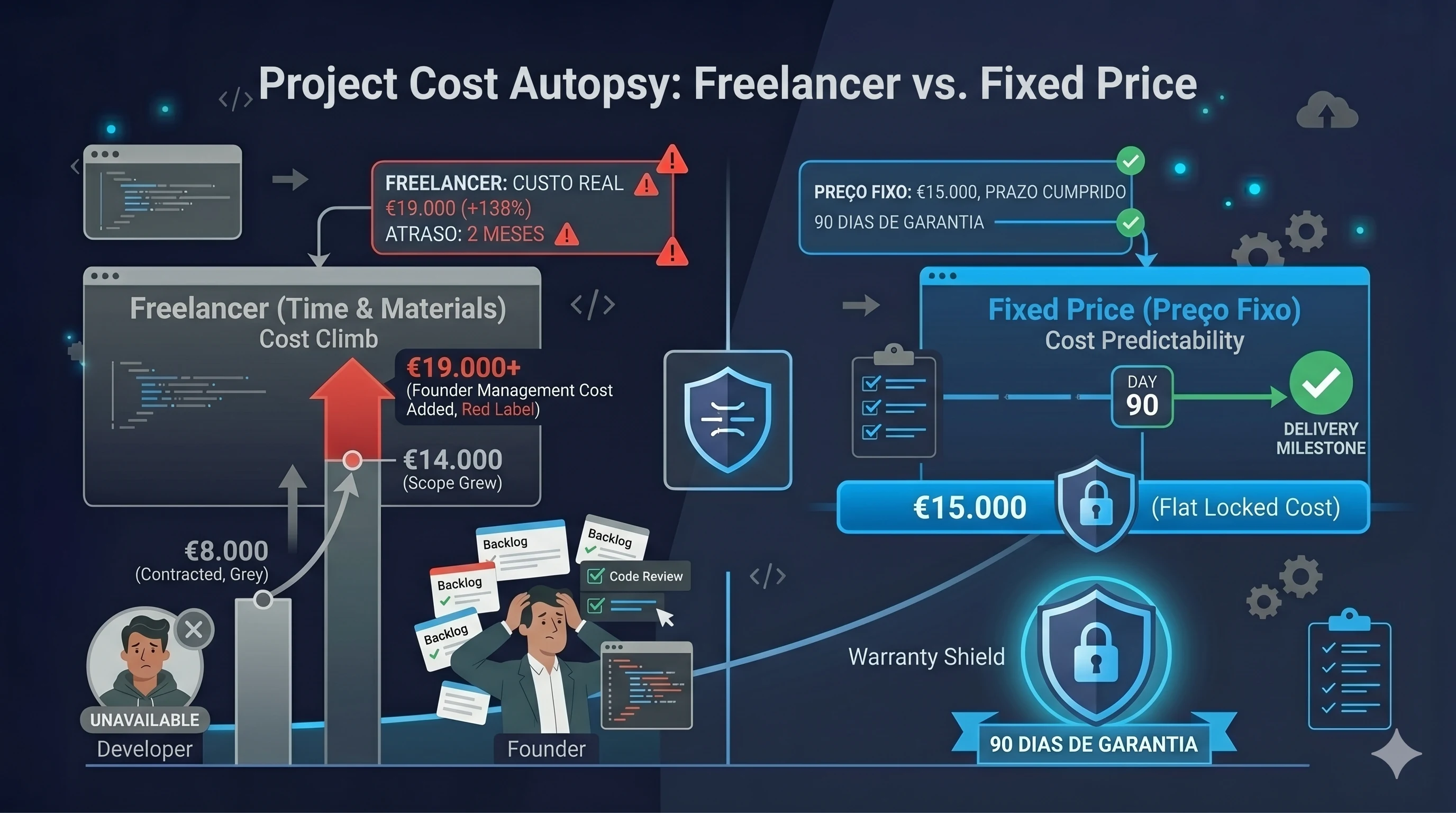
A concrete example. A company hires a freelancer for €8,000 to build an app in 3 months. By the end of month 5:
- Hourly cost reached €14,000 (scope grew)
- The founder spent 8 hours/week managing the project (€5,000+ in opportunity cost)
- The app launched without real production testing, generating 3 weeks of critical bugs
- The freelancer is no longer available for fixes
Real total cost: €19,000+ and a 2-month delay. A fixed-scope project for the same original scope would have cost €15,000, delivered on time.
When a freelancer makes sense
- Discrete, well-defined tasks (building a component, fixing a specific bug, a simple integration)
- When you have internal technical capacity to manage and do code review
- When scope and deadline risk have no critical commercial impact
- Low-budget projects where the risk is acceptable
When fixed-price makes sense
- You need a complete product with a defined deadline (MVP, platform, app)
- You don't have internal technical capacity to manage and QA
- The product goes to real customers and can't have launch instability
- You want predictable cost and contractual accountability from the people delivering
The right decision depends on who absorbs the risk
In the freelancer model, you absorb the risk of scope, timeline, and quality. In the fixed-price model, the agency absorbs it. What you're buying with a fixed price isn't just development: it's risk transfer.
If you can manage the risk yourself (you have a technical team, a flexible deadline, controlled scope), a freelancer can be more efficient. If you can't, fixed-price tends to be cheaper in the end.

Fixed-scope project from €5k to €50k
Defined scope, fixed price, 90-day delivery. Real product with senior Brazilian team led by a strategic CTO.
Request a diagnosis