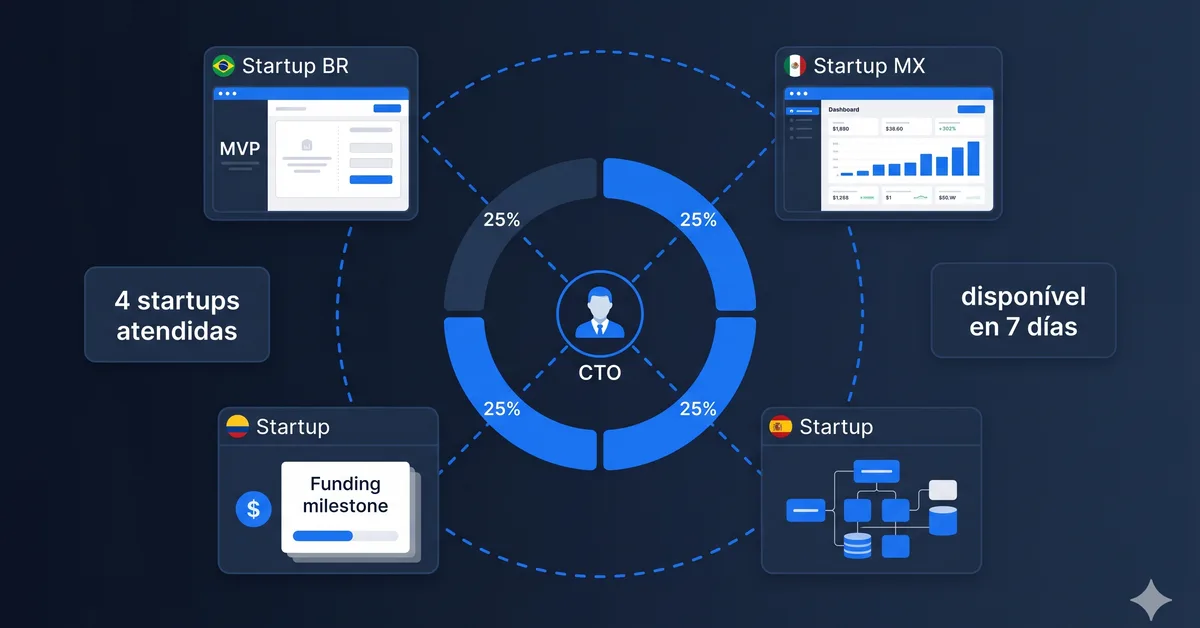

Fractional CTO for LatAm Startups: what it is and when you need one
Most fractional CTO content written in English assumes a premise that does not always hold in Latin America: that senior technical talent is abundant and accessible. In Brazil, Mexico, Colombia, and Argentina, that premise has important nuances that change the logic of when to hire, how to evaluate, and what to expect.
This article is written for international investors, founders, and operators evaluating the fractional CTO model in the LatAm context, and for LatAm founders who want a clearer framework for making the decision.
Why LatAm has its own rules
The fractional CTO model described in North American and European content assumes one thing: an abundant supply of senior tech talent. In LatAm, that assumption does not always hold. The markets of Mexico City, São Paulo, Bogotá, or Buenos Aires have quality talent, but demand exceeds supply. The best senior developers have options at well-funded startups or at international tech companies paying in USD.
This changes the logic of the fractional CTO in LatAm: sometimes the primary value is not strategic decision-making capacity, but access to the CTO's talent network. A fractional CTO with a developer network in Medellín or Buenos Aires is worth more than one without that network, regardless of individual technical capacity.
The regulatory context is also fragmented: each country has its own labor law, invoicing requirements, and data protection regulation. A fractional CTO who worked exclusively in Spain or the US does not know the specifics of hiring under Brazilian CLT contracts, issuing fiscal invoices in Mexico, or complying with Colombia's data regulations. That local knowledge is not a secondary concern: it affects technical and team decisions from day one.
The fractional CTO market across LatAm
Prices vary by local market, CTO experience, and engagement scope. Reference ranges for 2026:
USD pricing is increasingly common for founders seeking stability against currency volatility. In Argentina especially, many professionals prefer contracts denominated in foreign currency. Compared to a full-time CTO in these markets, the fractional model represents 35 to 60% of total cost depending on seniority and scope.
What a fractional CTO does in the LatAm context
The core responsibilities are the same across markets: architecture decisions, technical team management, investor communication, technical debt management. But the regional context adds three specific dimensions:
Localized talent acquisition
Understanding how to hire in each local market, including its legal and cultural particularities, and when it makes sense to hire cross-border (a developer in Argentina for a startup based in Colombia, for example, with the cost savings that implies). A fractional CTO in LatAm should have clear criteria for when the savings justify the management complexity.
Infrastructure for local markets
Cloud, payments, compliance, and invoicing decisions specific to each country: CFDI in Mexico, NF-e in Brazil, electronic invoicing in Colombia, LGPD compliance in Brazil or its equivalents elsewhere. An error in these decisions is not just technical, it is legal and regulatory.
Speed versus scalability in early stage
The LatAm context often demands MVPs in 6-8 weeks on budgets smaller than European or North American equivalents. A LatAm fractional CTO needs to know when technical quality trade-offs are acceptable in early stage and when they are not, because the cost of repairing accumulated technical debt later can far exceed the initial savings.
When a fractional CTO has the most value in LatAm
Three situations where impact is highest:
Non-technical founder raising a round from international VCs. US, European, or global investors putting money into LatAm run technical due diligence. You need someone who can answer it credibly, in English when needed, and who understands what questions they will ask about architecture, security, scalability, and technical debt.
Startup with a technical team of 4-6 people that grew without formal technical leadership. The code works, but technical debt is accumulating. The next feature sprint will be twice as hard as the last, because nobody defined standards, there is no real documentation, and architecture decisions were made by each developer according to their own judgment.
LatAm startup with a validated product scaling to multiple countries. Going from one country to three or four is not just a business problem: there are architecture decisions that determine whether the expansion takes 3 months or 12. A fractional CTO maps out the technical roadmap before the problems start.
Differences from the European model
| Criterion | Fractional CTO Spain / Europe | Fractional CTO LatAm |
|---|---|---|
| Average price | €2,000 – 6,000/month | USD 1,500 – 5,000/month |
| Regulatory focus | GDPR, EU law | Per country: LGPD, INAI, etc. |
| Talent network | EU market and nearshore | Local network by city/country |
| Working language | Spanish / English | Spanish / English / Portuguese |
| VC meetings | English frequent | English for international VCs |
| Payment context | EUR / USD stable | Currency volatility in some markets |
How to find a fractional CTO in LatAm
Three channels that work in practice:
Founder networks in the local ecosystem. The best fractional CTOs do not advertise on platforms, they come through referrals. If you participate in startup communities in your city or country, those references are more reliable than any platform listing.
Accelerators with CTOs in their network. Y Combinator, 500 Startups, and LatAm-specific accelerators like Platzi Startups, NXTP Ventures, or Wayra have mentor networks with specific LatAm startup experience. Many of those mentors offer or know fractional CTO services.
Technology firms offering CTO as a Service. Some technology companies combine the fractional CTO role with development execution. This can make sense for startups that need technical leadership and development at the same time, without the complexity of coordinating two separate vendors.
BeC System runs this model with LatAm presence built in: architecture decisions and strategic direction come from the São Paulo engineering team, while the Cali, Colombia office, led by LatAm Director Hector Cachiotis, covers the regulatory and commercial context for Colombia, Peru, Chile and neighboring markets, in the GMT-5 timezone. See the full team and office structure.
What to avoid: Upwork or freelancer platform profiles that describe their service as "CTO as a Service" but are in practice senior developers without real technical team leadership experience. The difference is not in the title, it is in what decisions they made, what teams they built, and what problems they solved.
Frequently asked questions
Can a fractional CTO based in Europe work for a LatAm startup?
Yes, and there are cases where it makes sense: startups with technical teams in LatAm that want European presence, or those with European investors who value that profile. The main challenges are timezone differences (6-7 hours between Spain and Colombia or Brazil) and limited knowledge of local talent markets and regulatory environments.
What is the difference between fractional CTO and CTO as a Service?
The terms are often used interchangeably. CTO as a Service sometimes implies a firm or agency model, where a provider delivers the CTO function with a rotating team. Fractional CTO typically means a specific person with continuous accountability. For early-stage startups, the specific person has more value than the generic service.
How long does a fractional CTO engagement typically last?
Six to 18 months in most cases. Less than 6 months is rarely enough to generate structural impact. More than 18 months typically signals that the startup should be hiring a full-time CTO, or that the engagement is not evolving toward internal team autonomy.
Does BeC System offer fractional CTO services for LatAm startups?
Yes. The BeC model includes architecture decisions, technical team management, and development with fixed scope. For early-stage startups that need fractional CTO plus development, the integrated model avoids the overhead of coordinating multiple vendors. Let's talk directly.