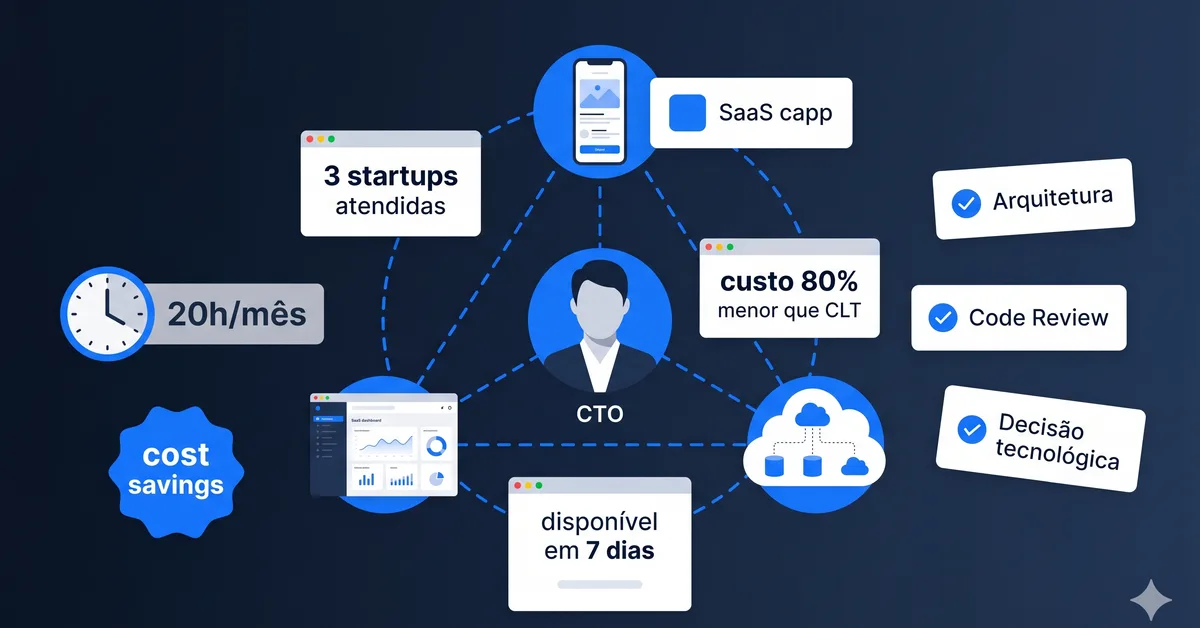

Fractional CTO for Startups: when to hire and what to expect
Your startup is growing. Developers are shipping, the product is moving forward. But the important technical decisions still depend on you, the non-technical founder, or on your lead developer who has no bandwidth to think about architecture while shipping features.
This is when most founders ask for the first time: "do we need a CTO?" The answer is almost always yes. The real question is: a full-time CTO or a fractional one?
What a fractional CTO actually is
A fractional CTO works for your company part-time, typically 2-3 days per week, with real accountability over strategic technical decisions. This is not a consultant who delivers a report and disappears. It's someone who takes on the CTO role with all its responsibilities, without the full-time commitment.
The difference from a freelancer or IT consultant matters:
- A freelancer executes tasks: writes code, configures, delivers.
- An IT consultant gives diagnoses and recommendations.
- A fractional CTO makes decisions, owns them, and implements with the team.
What they actually do
Architecture and stack decisions
Choosing between microservices and monolith, which cloud to use, which database scales with your business model, whether to build or buy. These decisions have multi-year consequences and shouldn't be left to developers who joined three months ago.
Building and managing the technical team
Defining which profiles to hire, evaluating technical candidates, setting up onboarding, building the engineering culture. A fractional CTO can also connect your startup to their developer network and technical partners.
Investor communication
Translating technical strategy into business language for your pitch deck, handling technical due diligence from VCs, presenting the technical roadmap to the board. Non-technical founders benefit from having someone credible handle this.
Technical debt management
Identifying which legacy code is a real growth risk versus what can wait. Prioritizing without freezing. Knowing when to rewrite and when to patch.
Development process
Implementing or improving team workflows: CI/CD, code review, release management, production monitoring, incident response. Teams without these processes scale with a lot of friction.
When it makes sense
Hire a fractional CTO when:
- You have a working product and the engineering team is going to grow in the next 6 months
- You're preparing a seed or Series A round and VCs ask technical questions nobody answers well
- Your technical co-founder is buried in code and can't lead the team
- Architecture decisions are being made by the most senior developer, without long-term vision
- You have recurring quality problems: production bugs, releases that break things, technical debt growing unchecked
Don't hire when:
- You're still validating the idea with a 1-2 person team
- A technical co-founder with leadership experience can cover the strategic decisions
- The fractional CTO you find has a developer profile, not a technical leader profile
Fractional CTO vs. alternatives
| Role | Makes decisions | Leads team | Writes code | Cost |
|---|---|---|---|---|
| Fractional CTO | Yes | Yes | Sometimes | Medium |
| Full-time CTO | Yes | Yes | Rarely | High |
| IT Consultant | No | No | No | Variable |
| Senior Freelancer | No | Partial | Yes | Medium |
How to evaluate a fractional CTO before hiring
Four questions that separate a real CTO from a developer who calls themselves one:
1. Can you describe an architecture decision you made, the alternatives you considered, and why you chose that path? If the answer is technical but doesn't mention business or team impact, that's a problem.
2. How do you prioritize technical debt vs. new features? The right answer isn't "always debt" or "always business." It's a risk and cost analysis process.
3. What would you do if the engineering team disagreed with your architecture decision? You want leadership, not authority. A CTO who always overrides creates teams that stop thinking.
4. How many startups are you working with at the same time? A fractional CTO juggling 8 companies has no real capacity to be accountable for anything. Look for someone with 2-3 active projects maximum.
How BeC works
We offer CTO as a Service for startups and growth-stage companies. Not just technical advisory: real accountability over architecture decisions, team, and deadlines.
If your startup needs to scale its engineering team, prepare a funding round, or solve a structural architecture problem, we can talk. No 20-field forms: one message is enough.
FAQ
What does a fractional CTO do that a senior freelancer doesn't?
A senior freelancer executes technical tasks. A fractional CTO makes strategic decisions and owns them: chooses the stack, defines the architecture, hires the team, talks to investors. The difference is accountability and strategic perspective, not hours of code.
How much does a fractional CTO cost?
Typically $3,000 to $8,000 per month for 2-3 days per week in US/UK markets. In Spain and LATAM, the range is $1,500 to $4,500 USD per month. Price varies by startup stage, product complexity, and whether the CTO brings a talent network.
When is it too early to hire a fractional CTO?
Too early if you're still validating the idea or if a technical co-founder can cover strategic decisions. A fractional CTO has the most impact when you have a working product and need to scale the team or prepare a funding round.