
Sales Gamification: What It Is and How to Apply It
If you want to apply something different that delivers excellent results for engaging and improving team performance, sales gamification is a great opportunity.
Selling more is the goal of any business, and that is certainly the challenge facing your sales team. However, it is necessary to identify truly differentiated strategies in order to outperform the competition and make teams increasingly efficient.
Gamification has been widely promoted as a perfect set of techniques for increasing team engagement.
We have prepared the following text to present the definition, benefits and applications of sales gamification.
In the material below you will also find details about how this innovative technique relates to marketing and advertising, so read on.
What exactly is sales gamification?
Gamification is the name given to the application of game design techniques and mechanics. The objective of this integration is to increase user involvement in the game.
Given its effectiveness and ability to improve engagement and learning, gamification can be applied in other areas, as a digital marketing technique to encourage engagement, for example.
In sales, gamification improves the salesperson's intuition and understanding. They come to understand that the team is made up of different people, but that there are goals and objectives common to all.
Games can greatly influence behaviour, guide our habits and influence our decisions. These and other attributes are deeply aligned with sales and marketing objectives.
However, the effectiveness of this tool depends more on motivational strategies than on purely economic ones.
Of course, to get the most out of a group of salespeople, a monetary incentive is important. But it is not the only one that works, and it is certainly not the most effective in terms of cost-benefit ratio for the company.
Discover the main elements of sales gamification below.
What makes up sales gamification?
Since we are talking about different areas, gamification in games differs from gamification in sales.
For this reason, we have separated the main components of sales gamification into:
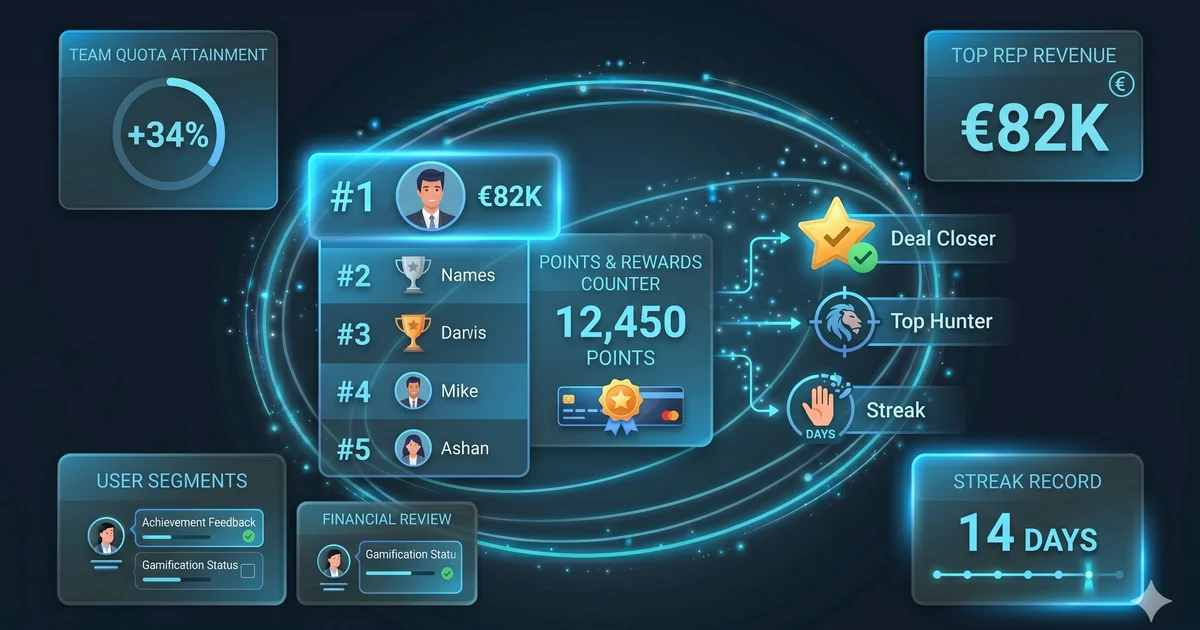
- Leaderboard;
- Real-time feedback;
- Points;
- Missions;
- Rewards.
The leaderboard is a virtual ranking that shows each salesperson's results. Real-time feedback ensures that the team is always updated on its progress.
The points system serves to increase employee motivation and underpin the development of rankings.
Missions are the objectives that employees must achieve. The ideal is to create a versatile set of missions.
Rewards go beyond cash bonuses. They are digital, as is typical in the gaming sphere, and target the psychological dimension of the user.
What are the benefits of sales gamification?
The time has come to understand in more detail the ways in which gamification can help in sales among so many other possible business areas.
The advantages relate to relationships between employees, stress reduction, and much more.
Increased competition among salespeople
Salespeople are competitive by nature. Allowing them to pursue business objectives enables the area manager to reinforce the ambitions of their team.
Often, the reward is not the salesperson's incentive in itself, but rather the recognition of the manager and colleagues.
This can be further improved by using a system capable of stimulating attention towards statistics, missions and incentive campaigns.
Stress reduction
Managers can become very exhausted from making demands of the team. This not only causes stress, but also takes up a great deal of time in the day that could be focused on other activities.
Thus, through gamification strategies, new incentive formulas are discovered.
The playful approach can reduce the natural wear of being held accountable for results. In turn, everyone's productivity increases.
Recognition of the best salespeople
Games can be used to inspire teamwork based on the idea of winning prizes for the efforts made and results achieved.
This achievement not only shows the manager who the most outstanding talent in the company is. It also shows which operational actions and attitudes deserve more encouragement in other employees.
This is how the team begins to improve collectively.
Conducting feedback sessions
Based on the concept of collaboration promoted by competitions between salespeople, there will be more opportunities for dialogue between the manager and their subordinates.
This is a facilitating factor for the sales feedback process, whether individual or group.
This practice can happen naturally, as employees will be able to identify their strengths and weaknesses based on their ranking in each type of competition promoted by the company.
Furthermore, it can encourage employees with a lower volume of conversions to sell more.
Creating a more productive environment
The challenges of a sales career tend to be rewarding, even more so when personal and professional objectives are achieved.
In the business world, there are two factors that drive this motivation: remuneration and career growth opportunities.
With a pleasant working environment, people tend to dedicate themselves more to all the functions of the area, including reports and other bureaucratic work related to the commercial area.
How are gamification and digital marketing related?
Basically, a company can share its strategic activities to get people to interact with it, especially on social media.
Facebook has around 100 million users worldwide. In Brazil alone, there are more than 213 million active profiles. Therefore, it is no exaggeration to say that about half the population is using the platform.
Those working in the clothing sector can create a look-building system with interactive mannequins, for example.
Through small competitions and challenges, the company promotes its image in the virtual environment through users' shares.
At the same time, follower engagement also increases. This attracts and retains new followers and potential clients.
Gamification can be used for companies to encourage the completion of tasks in exchange for rewards or digital recognition, and this can even be done in this style among salespeople.
Above all, this happens naturally. That is, people do not realise they are being influenced by a business. Engagement comes organically.
How to apply gamification in sales
To conclude, we offer tips and best practices for gamification to be well applied in sales companies and other sectors.
The manager should act as a guide within the new productive environment being created. Find out how below.
Prepare teams to compete
When it comes to team incentives, cash rewards are usually the first motivators. But motivation is directly linked to productivity and other objectives.
In this way, the most effective way to improve performance is to implement sales incentive programmes.
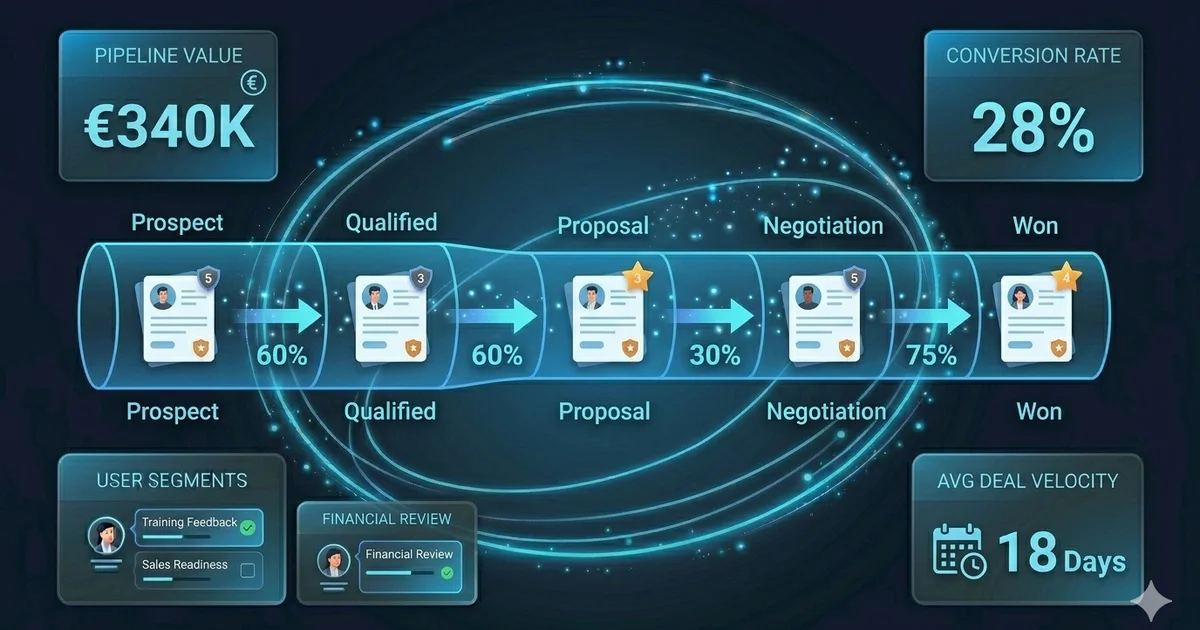
When you track sales and add incentives, you are setting the right variables to drive the professionals involved.
It does not necessarily have to be a cash bonus. A day off or small gifts can also be very welcome.
Identify the metrics you want to track
Once gamification is in place, it is necessary to define the metrics that will be tracked in relation to the objectives for which gamification was implemented.
Consider what drives the business and incorporate these metrics into the challenges you create for the team.
In this way, you can define the most desirable objectives and the plans to achieve them.
Improve sales data
If your sales representatives are not fully engaged and refuse to track the integrity of sales data, there may be problems.
It takes time to process the data from all the leads your sales representatives interact with.
It is necessary to motivate them to adopt this practice systematically. Although laborious, it is essential to safeguard the data of buying and selling clients.
Furthermore, the clearer and more precise the data, the easier it will be to identify qualified leads.
Use results to compete
To make the gamification process more enjoyable, it is important to have a ranking available, so that everyone can monitor individual results and those of their colleagues.
The desire to be number one and increase the success rate motivates salespeople to work hard to be recognised and rewarded in one way or another.
Those who think that competition is bad are mistaken. When competition is established within a healthy team, it helps to guide everyone involved and build qualified internal communication.
Sales gamification is a very innovative and beneficial phenomenon for various types of businesses.

Technology that shows up in your P&L
Code that generates revenue, not slides. Fixed-scope projects with defined scope, price and timeline before we start.
Request a quote