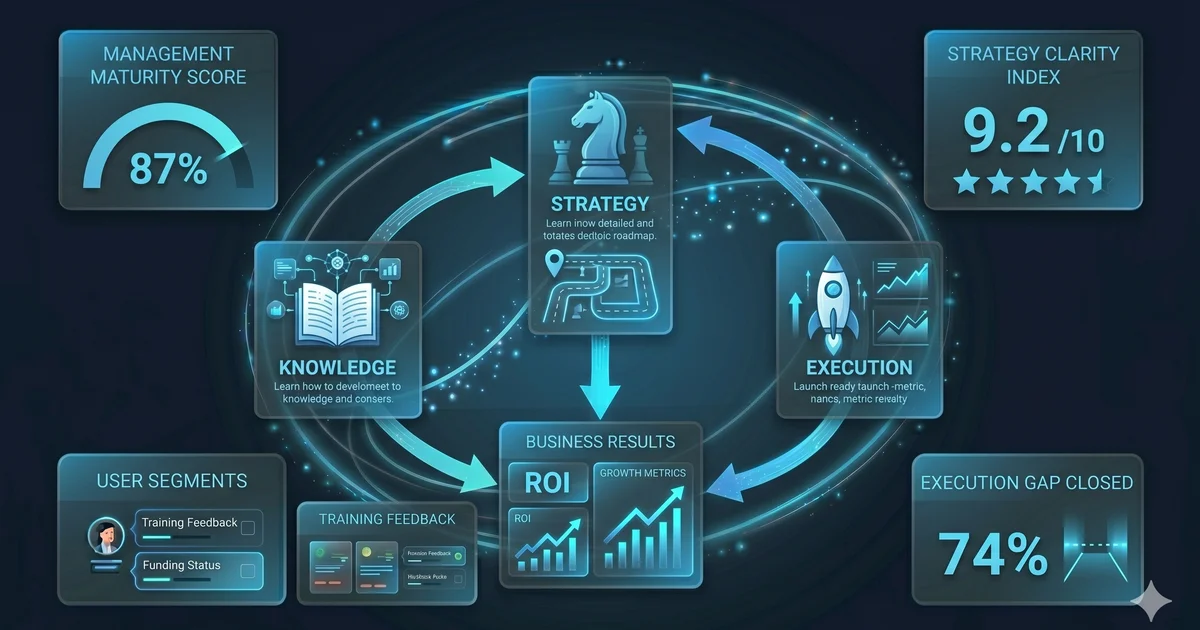

Start Your Business with the Right Management Knowledge
The recipe for a successful venture holds no great secret. The foundation is sound management knowledge. From there, every other path will unfold in the right direction.
Just as there is no magic formula, it is also not impossible to learn the key steps and understand how to go about entrepreneurship in this way.
With that in mind, we have prepared this article to help you, the entrepreneur. Whether you work in the technology sector or focus on selling clothing, sound management knowledge is the first step towards building your career appropriately.
Read the content we have prepared below and leave here knowing the main possible means towards good management.
Understanding Entrepreneurship
Starting out as an entrepreneur is a good alternative for any manager.
This is because it represents the scenario of a new business with profit potential and the creation of new jobs for employees, delivering a significant improvement in the national economic landscape.
This practice demands a great deal of wisdom and care. We are dealing with money, other people's and our own. In this sense, a well-thought-out strategic plan is necessary before starting work.
A SEBRAE study concluded that the mortality rate of small businesses in the first five years is between 17% and 21%. This demonstrates the need to think carefully about a good action plan and sound management knowledge.
This applies to any kind of service: from a specialist shop to the sale of sweets and snacks.
All are entrepreneurs, all have a venture, and all must know how to apply the best planning to generate profit.
It is also worth knowing that there are several types of entrepreneurship that can be applied. They are:
- Digital entrepreneurship;
- Business entrepreneurship;
- Corporate entrepreneurship;
- Social entrepreneurship;
- Green entrepreneurship;
- Women's entrepreneurship;
- Individual entrepreneurship, the well-known MEI;
- Cooperative entrepreneurship.
Can you see how broad and fragmented this area is? You can specialise in one model and expand it towards your area of interest, whatever product or service you prefer.
Understanding the Market
One of the first steps in setting up a new venture is getting to know the market in which you want to operate, that is, carrying out a thorough investigation of what has already been done and is currently being done with your product.
In this way, you will be ready to present a creative product or an innovative delivery process, in order to stand out from the competition.
After all, there is no point starting a new business if the same product is already being sold in the same way by competitors.
One thing is to offer the service at a fair price to the consumer; another is to sell the service in an unattractive way.
To that end, a persona study should be carried out at the start of the work. The persona is that ideal customer, defined by age, gender, hobbies, location, and many other attributes. The better you know your persona, the faster you will sell to the right person.
Another piece of customer data worth understanding relates to their communication channels.
Which social networks do they use most? How do they communicate online? Be where they are, speak in the same way, and win far more customers to establish your business.
Tips to Apply in Management
An entrepreneur must know some essential tactics to maintain sound management knowledge. These are ideas that will always be replicated by the best companies. See some of them below.
1. Make a good plan
At the start of every year, map out all your revenue, investment, and production. Create a business plan covering everything most necessary to keep your venture alive.
This first step is important for anticipating any surprise expenses and service maintenance costs.
Will you need to hire a company to fix a system? Start researching some names and make a few calls. Do not leave it to the last minute.
Planning can also be done periodically: every 6 months, every 3, or monthly. It is always necessary to assess the current state of the business and what can be done to boost it.
By doing so, you can understand whether it is the right moment to start a new business, plan your persona, product, channels of operation, documents, and everything else necessary for your context, or to put those actions into practice.
2. Define clearly what you will sell
Do not rush into offering various product options all at once. Focus on a single idea, service, or product, go deeper into it, and keep developing further from that point.
It is natural to rush and start thinking about various ideas and activities right at the beginning of setting up the business; however, it is precisely the opposite that should be pursued: plenty of patience and keeping both feet firmly on the ground.
This is also the time to let your idea mature properly. Ask yourself many questions, consult colleagues, assess market risks, and feel ready to roll up your sleeves.
3. Pursue content marketing
A good entrepreneur never stops staying up to date with new market demands. One of them is digital marketing and content marketing.
There is no longer any room for traditional marketing when your future customer is connected to the internet 100% of the time, accessing social networks and communicating with people via messaging, audio, and video applications.
In this sense, find out which social networks your persona uses most, create a profile on each one, and publish content that resonates with your persona's world.
It is through content marketing that you will build authority and become a point of reference in the market, for competitors and, above all, for your customer. Get to know your persona's pain points and aspirations, and publish content that speaks to them.
It is also important to have a website so that people can find your company by typing its name into Google. Make sure you register your address, contact details, phone number, and photos so that people can reach you when they find your listing.
Whether it is a list of the best technology products put together by your shop's communication team, or fashion trends for your clothing store, the options exist for every entrepreneurial niche.
4. Take courses and training
We are never too old to learn, and there is always something new we will not know where to begin with. In this sense, it is excellent to invest in courses and workshops related to your area in order to improve your entrepreneurial skills.
Take, for example, the topic of digital marketing. Many people do not know the theory and practice of this activity. If you have the financial capital to invest in an agency or consultancy, do not hesitate to hire a professional team to take care of that area.
Otherwise, it is well worth seeking out free marketing courses yourself to apply all the knowledge in your business, whatever type of establishment or service you run.
Teachers and students will exchange experiences, pass on acquired knowledge, and teach the digital processes of the best tools, and you will leave far better equipped than when you started, ready to work in the marketing field with a focus on your business.
5. Keep an eye on digital metrics
A complex topic that you can learn about and get to grips with in a course is digital metrics. The best companies manage to grow profitably thanks to monitoring the metrics of their work.
There are various types of metrics and they are used to track brand development during the activation of a campaign, the relationship with the audience, the level of sales, and many other possibilities.
Only by knowing and having access to the right metrics will you be able to tell where it is best to invest and where it is better to pull back a little on capital, so that your venture keeps moving in the way you want.
Start Your Venture Now
After all our tips on sound management knowledge, you are now ready to start your business in the best possible way, following good strategies, reaching your persona in the right manner, and boosting your sales.

From MVP to real product
3R Framework: before the first commit, your project passes through Real Friction, Business Rule and Return. If it doesn't pass, it doesn't start.
Start diagnosis