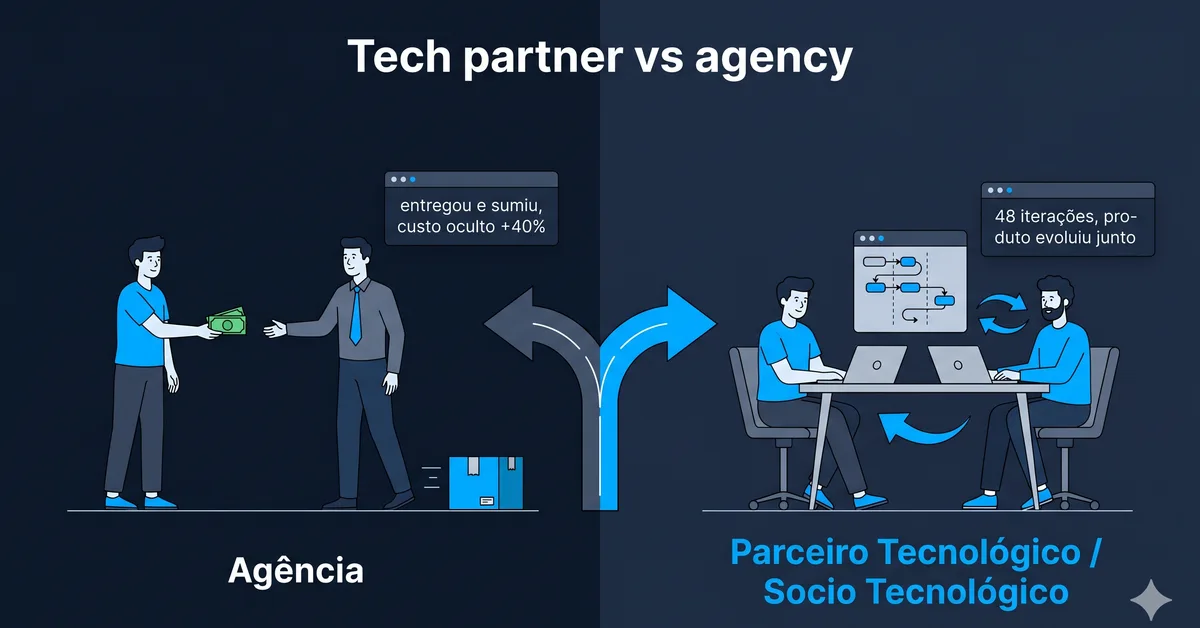

Tech Partner vs. Development Agency: what's the difference for your startup
When a startup looks for external technical help, it typically finds two options that look similar on the surface: development agencies that talk about "dedicated squads" and "we work as an extension of your team," and tech partners that promise something deeper. The problem is that the marketing vocabulary of both is nearly identical.
The real difference is not in the website copy. It is in who takes responsibility when something goes wrong.
The real difference (not the pitch version)
Development agencies describe their services using partner-adjacent language: "dedicated team," "part of your team," "we work as your extension." In practice, the distinction is about accountability.
An agency delivers what you described in the brief. If the brief was wrong, the delivery will be too, and the agency will have fulfilled the contract. A tech partner enters earlier: they help define what to build, take responsibility for whether it works, and stay present when something breaks.
The question is not who charges more or who has more experience. It is who takes responsibility for the outcome.
This distinction seems subtle, but it has concrete consequences. An agency that delivered exactly what you asked, without questioning whether it was correct, fulfilled the contract. You can dispute bugs, but you cannot dispute a product that failed in the market because no one told you the approach was wrong.
A tech partner has a different incentive structure: if the product fails, they lose reputation and client. If it succeeds, they gain scope expansion, reference, and a long-term relationship. That alignment changes how they work, what questions they ask, and when they push back.
When an agency makes sense
Agencies are the right choice when you know what to build and only need execution. Examples where an agency delivers real value:
- You have a validated MVP and need to ship it to production with a team you do not want to hire permanently.
- You have a technically specified feature and want to ship it in 6 weeks without expanding the permanent team.
- You need visual design for a product whose architecture is already decided and documented.
- The project has a fixed scope with clear dates and the requirements will not change.
In those cases, the agency delivers real value. A deliverables-based contract makes sense when the deliverables are well defined.
The problem appears when the founder believes they know what they want to build, but they do not. This happens more often than it looks. Most founders at early-stage startups have a product hypothesis, not a technical specification. The difference between the two is enormous when it comes time to sign a contract with an agency.
When you need a tech partner
A tech partner makes sense when technical decisions are still open and carry long-term consequences. Concrete situations:
- You are building the first MVP and do not have a technical co-founder who can make architecture decisions with strategic vision.
- You need to choose between architectures and today's mistake will cost 6 months of rewriting in 18 months.
- You are raising investment and VCs will run technical due diligence. You need someone who can answer it credibly.
- The technical team is growing and someone needs to define how they work, what standards they follow, how they do code review.
- The product has accumulated technical debt and nobody knows which parts represent real risk versus what can wait.
The key difference: a tech partner cares whether the product works, not just whether the tasks are completed. That distinction determines what conversations happen, when someone has the courage to say "this is wrong," and when speed gets traded for technical soundness.
Fixed-scope pricing as a signal
Fixed-scope development fits well with agencies executing a defined scope. The client defines the scope, the agency delivers within it, invoices, and closes.
The problem with applying fixed scope to tech partner relationships is that an early-stage product's scope changes constantly. If the scope does not evolve, the product does not learn from the market. And if the partner charges by fixed scope, they have an incentive not to change it, even when changing would be right.
A good tech partner has incentive alignment with the outcome: if the product fails, the partner loses reputation and client. If it succeeds, they gain scope expansion and reference. That alignment is what makes the partner say uncomfortable things when it needs to be said.
Fixed scope is not synonymous with agency, and retainer is not synonymous with partner. What matters is the accountability model, not the billing model.
The decision table
| Criterion | Agency | Tech partner |
|---|---|---|
| Scope clarity | High, defined | Low, evolving |
| Responsibility for outcome | Brief execution | Product outcome |
| Participation in technical decisions | No | Yes |
| Actively recommends changes | No | Yes |
| Relationship type | Project | Extended team |
| Pricing | Per project / hour | Per outcome or retainer |
| Ideal for | Defined features | Early-stage products |
How to tell if it is really a partner or an agency using partner language
The marketing vocabulary of many agencies has absorbed tech partner language. "We own your technical outcomes" or "we are your extended team" appears on agency websites that function exactly like agencies in practice.
Two interview questions that reveal the real difference:
First question: "When was the last time you told a client that what they were asking for was a mistake?" If the answer is vague, they cannot recall, or they speak in abstract terms about "always thinking about the client," you are looking at an agency with partner vocabulary. A real partner has a concrete story: they remember the client, the context, what they said, and what happened.
Second question: "What was the worst technical advice you gave a client?" Real partners answer directly, because they gave advice and owned it. Agencies do not remember, because they did not give advice, they delivered what was asked.
Also worth checking the contract: does it have clauses about responsibility for the outcome, or only for the delivery? Agency delivers. Partner is accountable. The difference is in writing before you sign.
The BeC model
At BeC we work as a tech partner with a fixed-scope model. Scope is defined together, with shared accountability for the outcome. If what you asked for is not going to work, we say so before building it.
For early-stage startups that need a technical partner with real accountability over architecture decisions, the team, and timelines: we can talk directly, no 20-field forms.
Frequently asked questions
Can you start with an agency and switch to a tech partner later?
Yes, that is the typical path. The agency builds the MVP, the tech partner takes over to scale. The problem shows up when the MVP was built without scalability in mind and the partner inherits accumulated technical debt. In those cases, the first job is figuring out what can be reused and what needs to be rewritten.
Is a tech partner more expensive than a development agency?
Price is not the right metric. A tech partner can cost less overall if they prevent the expense of rewriting what the agency built incorrectly. An architecture mistake in a product with 50,000 users can mean 3 to 6 months of rework. Compared to that, the price difference in the original contract is small.
Does BeC System work as a tech partner or as an agency?
As a tech partner with a fixed-scope model. Scope is defined together, with shared accountability for the outcome. If what you asked for is not going to work, we say so before building it.
Can an early-stage startup afford a tech partner?
Usually yes, because the fractional or fixed-scope model adjusts the budget to the stage. The right question is not whether you can afford a tech partner, but whether you can afford the cost of building the wrong thing.