
Break-even point: how to plan your company's revenue
Just as in yoga classes and in everything in life, maintaining balance is fundamental to having a better life with greater control, and when we think about the corporate market and everything it represents, it is also necessary to find that point.
We know that entrepreneurship is not exactly easy, but we must understand that it is one of the most profitable ways of working. It is no coincidence that the wealthiest people in the world are business owners. This path is therefore very appealing to many.
With this in mind, today's article will contextualise what the break-even point is and its importance for a company, exploring what it is and how to plan for it, as well as the different types that exist and their impact on the day-to-day running of your business.
From a service company to large clothing manufacturers, all businesses need to understand how their processes work and where their money comes from and where it goes.
A business can go through various stages throughout its lifetime, and understanding the variations that may occur over time not only contributes to the brand's success but also increases the likelihood of its expansion in the market.
Unfortunately, it is not uncommon for companies with great potential to go bankrupt or not achieve the expected success because they do not know how to manage so many variables, making it possible for even an innovative company to fail.
Therefore, having administrative, marketing, commercial, and even sales and marketing knowledge is necessary to ensure the health of your business, for example, and to allow it to gradually establish itself and invest in its own growth.
We can therefore say that knowing how to calculate this organisational information is fundamental, as only in this way will the company be able to continue operating in a healthy and efficient manner.
Regardless of the sector, whether in service provision or in a large automobile assembly plant, knowledge is always valuable.
The following sections will better contextualise what the break-even point is and why it is important for your business, showing how different types of break-even points exist and the advantages your brand has in finding them. Without further ado, read on.
The concept of break-even point
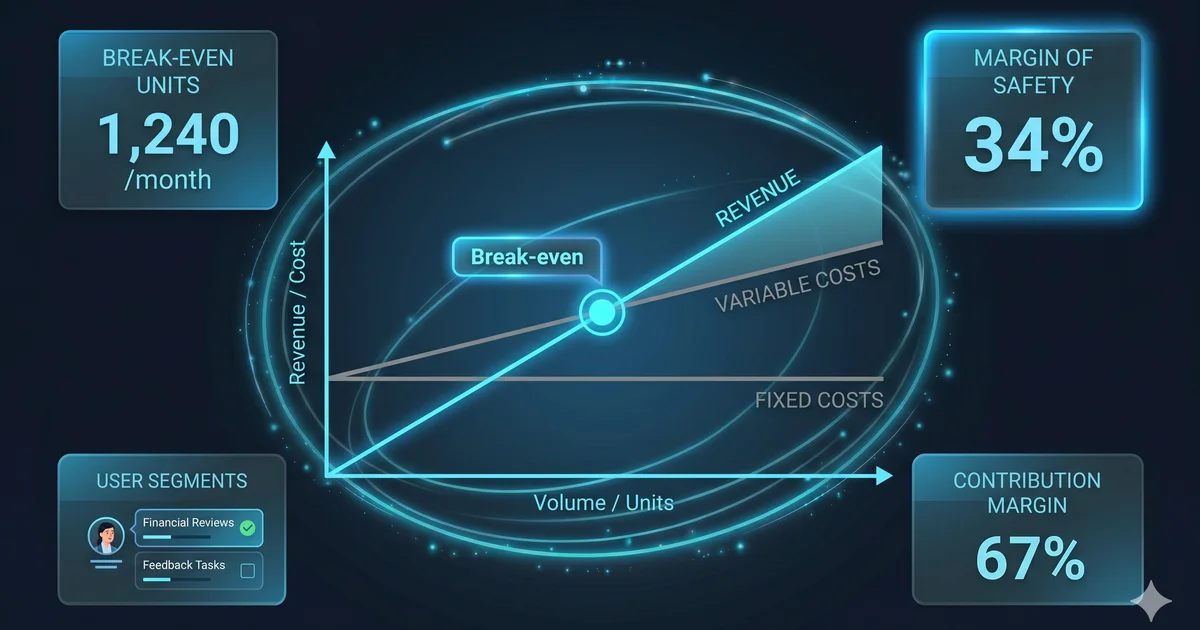
Although it was briefly mentioned at the beginning of the article, let us explore it in greater depth. We can call the break-even point the zero point of any financial turnover, the start of genuine positive earnings.
Regardless of whether the brand focuses on T-shirts or the sale of something else, it needs to pay bills to remain active in the market, and these outgoings can be numerous and vary from company to company.
After paying all the month's bills, when all incoming revenue is purely profit, we call that moment, when turnover reaches zero, the break-even point. In other words, it is at this moment that the organisation's true financial profit begins.
It is extremely important to find this point because when a company's goals and objectives are set, the likelihood of losses and negative setbacks for the brand decreases considerably, also reducing the chance of business failure.
In this way, your company can benefit from finding this break-even point, for example:
- Lower risk of bankruptcy;
- Controlled expenditure;
- Greater accuracy in overall revenue management;
- Higher probability of investment in other areas of the brand;
- Greater financial stability;
Of course, many of these benefits will depend on each brand and how it works with the information available, as well as how wisely it distributes its expenditure and use of capital.
There are various types of break-even points, and to help your company make the most of each one, let us better understand how they work below.
The accounting break-even point is the one we have discussed the most up to this point. It aims to use calculations and formulas of passive costs, such as expenses and bills, to reach zero and balance the equation for what is yet to come.
It is fairly straightforward to find it, simply calculate the contribution margin and add it to total costs, both fixed and variable, allowing even your business to find its break-even point.
The financial break-even point is practically the same as the previous one, differing only in the way it is calculated, as it does not include deductible expenses. To calculate it, it is necessary to know the costs and deductible expenses and divide them by the contribution margin.
Finally, but no less importantly, there is the economic break-even point which, unlike the previous ones, considers opportunities and possible investments as investment margin, thereby carrying out a kind of monetary correction.
To calculate it, it is necessary to know the value of fixed costs, add the minimum return on investments and company profit, and divide everything by the contribution margin. In this way, even a company can find the point in a more simplified manner.
Calculating the break-even point correctly
Understanding the correct way to calculate the break-even point is fundamental to ensuring accuracy and, as it directly impacts your company's finances, it is necessary not only to understand it but also to guarantee precision.
Therefore, the following sections will bring together a series of information that can be essential for carrying out the calculation correctly. Without further ado, read on.
01 - Calculate revenue data monthly
Having a basis of monthly calculations for determining the break-even point is necessary to ensure greater effectiveness throughout the process, but knowing monthly revenue over time is also essential for the estimate to be more accurate.
Not only that, but from an average it is also possible to see how the brand has been performing over time, which makes it easier to determine whether the calculation is correct or not. Not to mention the accounting related to the financial resources used.
When you know the value and the extent to which each resource is actually being used, this opens up many possibilities for the company to, in the future, cut costs if necessary and continue to find its break-even point.
02 - Define fixed and variable costs
To find the break-even point, you need to know how much money is coming into the account and how much is going out, but primarily you need to know how much you are spending on the company throughout the month.
To do this, it is necessary to understand which costs are fixed and which are variable throughout the month, after all, before we concern ourselves with how much we are earning, we need to ensure all the bills are paid.
Understand fixed costs as anything that will always be spent within your company and whose value, as the name suggests, is fixed. Bills such as rent, salaries, water, electricity, internet, and software services are some examples.
Variable costs, on the other hand, may include supplier costs, marketing campaigns for a specific month, outsourcing and last-minute hires, as well as general taxes and raw materials used.
03 - Continue analysing the calculation on an ongoing basis
We have seen some examples throughout the article of how to calculate the different types of break-even points, but this alone may not be sufficient to calculate correctly, after all, one month is different from the next and costs can also vary.
Therefore, as you calculate and get closer to the result, never forget to apply the values related to the contribution margin, which will certainly vary from month to month, and to take the necessary steps to ensure the minimum revenue for your brand is achieved.
This is because, strategically, the profit value must be greater than the costs so that the company not only understands the importance of the break-even point but also makes a profit and remains competitive in the market.
For this reason, it is important to analyse each month's debts, invoices, profits, and overall revenue in order to ensure the brand's success and growth each month, and to enable it to continue demonstrating its true potential to the market.

Strategic CTO as a Service
Weekly technical decisions, roadmap protection and senior team from €3,000/month. No scope creep surprises.
Talk to Carlos Brandão