
Budget and Forecast: How to Use Them in Business Budget Management
Good management depends on a number of factors, particularly with regard to a company's finances. In this respect, understanding what budget and forecast mean are important steps towards ensuring more effective financial control.
Most professionals who work with money have already heard these terms, particularly during the company's budget planning process. However, few people deepen their knowledge of the subject.
Moreover, many tend to confuse these concepts and fail to apply them correctly in their assessments, which ultimately creates a problem for the company as a whole.
Understanding each of them and how to use them is a very important process for ensuring more effective results for your company from the outset.
The concept of budget
The budget is a very important element for managing a company's finances. It represents the annual budget of a company, a way of setting financial targets and better understanding the costs and revenues arising from negotiations.
The term does not have an exact equivalent in every language, but it is important to understand that all its definitions are directly aligned with management, particularly in terms of financial planning for certain activities.
To draw up a budget correctly, it is necessary to bear in mind a number of factors and scenarios that come together to provide greater accuracy in the type of tool that will be used in the long term for your company.
The first step is to understand the company's history, what needs to be controlled, and what is inevitable. This type of analysis is normally carried out by evaluating the last period the company went through and the previous final assessment.
In this way, you can start with a better understanding of the company's finances, which provides greater confidence for making plans and assessments based on expectations.
The next step is to understand the market. No company operates in isolation, and you need to bear this in mind when assessing the environment surrounding the company and understanding how it interacts with the market.
This helps to better understand important issues such as seasonality, which indicates the company's best periods throughout the year, or even the vulnerability in which the company currently finds itself.
All this information helps to better understand your possibilities and the actions that need to be assessed so that you can secure an adequate position in the company, leading to the final step of the budget analysis.
Known as the «future», this is a speculative assessment that considers where the company can go if directed appropriately, understanding the challenges and opportunities that open up over the period.
The future is also responsible for setting realistic targets for the company. When an objective is set, it is important that there is a real chance of it being achieved, thus increasing long-term communication opportunities.
Furthermore, it is important to note that the objective of any company is growth, and the budget keeps the management team grounded and evaluates, with firmer criteria, the risks and challenges involved in pursuing that goal.
What is a Forecast?
Also known as an adjusted budget, the forecast is a very common term in the corporate world and is normally one of the first to be mentioned when drawing up a budget.
It is a fundamental resource, as it allows new adjustments to be made throughout the process, ensuring a more adequate structure for the preparation of the budget as a whole.
When carrying out long-term planning, normally over a period of one year, the forecast breaks it down into several shorter periods, allowing you to monitor the company's flow more effectively.
These shorter analyses normally have a one-month timeframe and allow for a range of activities, such as:
- Adaptations;
- Modifications;
- Course corrections;
- Strategy changes.
The focus of the forecast is to achieve the result projected in the plan, and that is why close monitoring is important to understand how the company is dealing with this type of situation.
The more you can optimise these processes, the easier it will be to understand the company's needs and how to adapt to obtain the best possible result within the evaluation period, preventing cash shortfalls and other long-term problems.
What is the difference between the two?
Now that you have a better understanding of the concepts of budget and forecast, it is important to bear in mind what separates each tool so that you can use them appropriately, ensuring a more in-depth analysis for the company.
In the case of the budget, the thinking is macro, that is, it evaluates an entire complete period, such as an annual review. For the results to be effective, it is necessary to analyse not only the company's history, but also the environment surrounding it.
The forecast, on the other hand, works in a more flexible way, evaluating shorter periods of time in a divided manner to identify flaws and losses in its actions and how to return to the course set out in the budget.
This means that, even though both are directly linked, they are different elements within a results assessment, which needs to be carefully considered by the management team.
In this way, you can have precise information about the progress of your production, ensuring far more effective results for the company as a whole, which ultimately helps to keep it in operation.
Most companies depend on a precise assessment of their finances to understand whether there is a possibility of growth or whether it is necessary to think of ways to deal with current difficulties, so that you can recover and remain relevant in the market.
How to apply these concepts in practice?
Financial control is one of the most important elements for any company, as it is the foundation of any administrative process. Today, there are many tools that speed up this process, particularly in the digital sphere.
This is a reflection of the process known as digital transformation, which has made many technological advances more popular and adopted by various sectors within a company, including management.
Advanced systems allow for rapid and precise assessment, often using tools such as advanced artificial intelligence to obtain answers with much greater accuracy and an almost negligible chance of error.
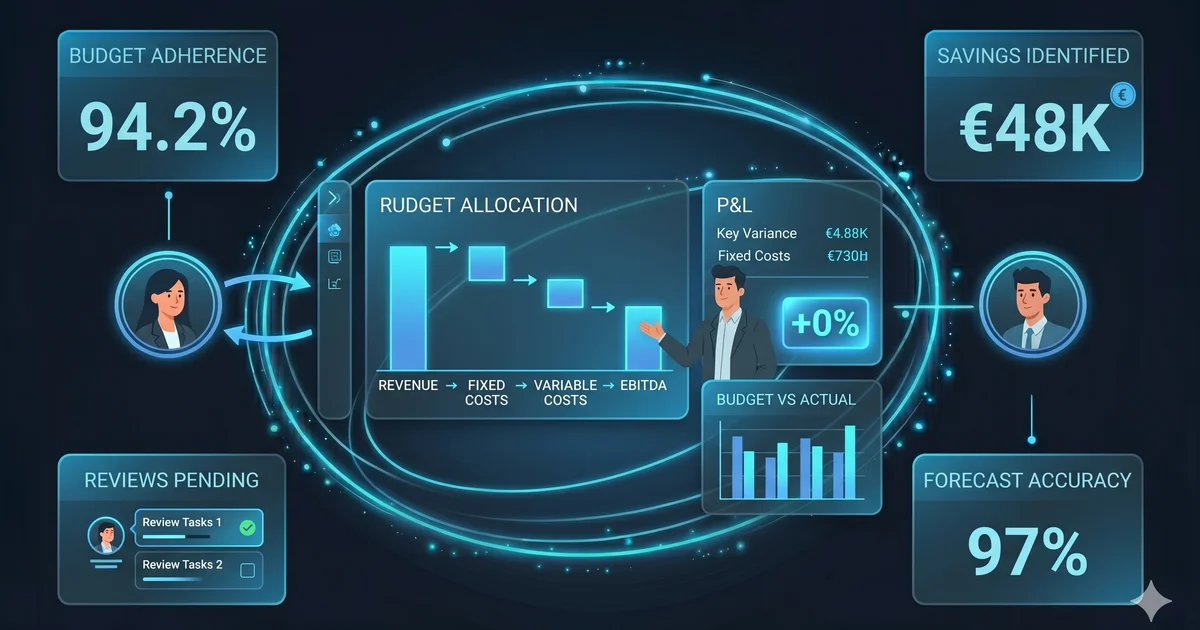
By entering your company's information into a management system, you can get a clearer picture of the entire period, quickly identifying the budget available to the company.
You can also better control your expenses by entering them into the programme, as it identifies where excessive spending is occurring that often does not need to be there.
The budget depends on a range of information from different sources, and this is normally carried out very carefully by the professional. However, with tools such as big data, this information emerges very quickly, enabling far greater interactions.
The next step is to support forecast tools, which require a shorter, divided analysis. With a digital tool it is possible to monitor the process month by month, even being able to identify and compare with previous periods of the company.
Projections are also divided effectively, taking into account the company's strongest and weakest months so that you understand exactly what kind of expectations to set for your results as a whole.
This type of tool helps to quickly identify important points of the forecast, making assessments more precise and well-executed, while allowing the manager to have more time for other more complex activities.
Another important element of this type of tool is the ability to monitor in real time the changes and revisions of each movement within the company. The projected figures are compared in real time with the company's actual results.
In this way, you can understand what is generating effectively positive results, and which actions need to be reconsidered and restructured for a future assessment.
Final considerations
Both the budget and the forecast are important tools for the financial management of any company and should be taken very seriously by the teams responsible for better structuring its finances.
In this way, you can ensure greater representativeness for your finances, understanding both how your company has reached this point and the projections of what may be found in the future, expanding your possibilities.
A company that has good financial planning can become an important brand in the market in which it operates, in many cases even securing leadership in the segment.

Strategic CTO as a Service
Weekly technical decisions, roadmap protection and senior team from €3,000/month. No scope creep surprises.
Talk to Carlos Brandão