
Types of Applications: Which Is the Best for Your Business?
With technological advances and the ever-growing expansion of online and offline business niches, there are several types of applications that can be used to improve productivity and performance in the working routine, including to reach audiences more effectively.
This is because various activities can be optimised with the help of resources that aim to streamline processes and provide better management of the stages of a project, for example.
In this way, the lack of optimisation tools can generate a workload backlog and significant challenges for managers.
Task organisation, content creation planning, financial management, online meetings, and communication networks are just some of the activities carried out daily in companies that can be improved with the support of applications that optimise time and help with performance.
After all, the main advantages of investing in different optimisation tools are:
- Improves the quality of activities;
- Increases productivity;
- Brings greater flexibility to operations;
- Reduces error and rework rates;
- Decreases communication mistakes;
- Standardises workflows;
- Increases efficiency.
This is possible because you can find everything from tools that help with time management to software for integrating team activities, or even for optimising processes involving recruitment and outsourcing.
An interesting point is that these tools and applications can be used across various segments, from manufacturing to communication and marketing agencies.
Types of applications and their functions
There are several types of applications that can be used for a wide variety of purposes. Understanding what each option has to offer can therefore be a way of deciding what your company needs and which tool best meets those needs:
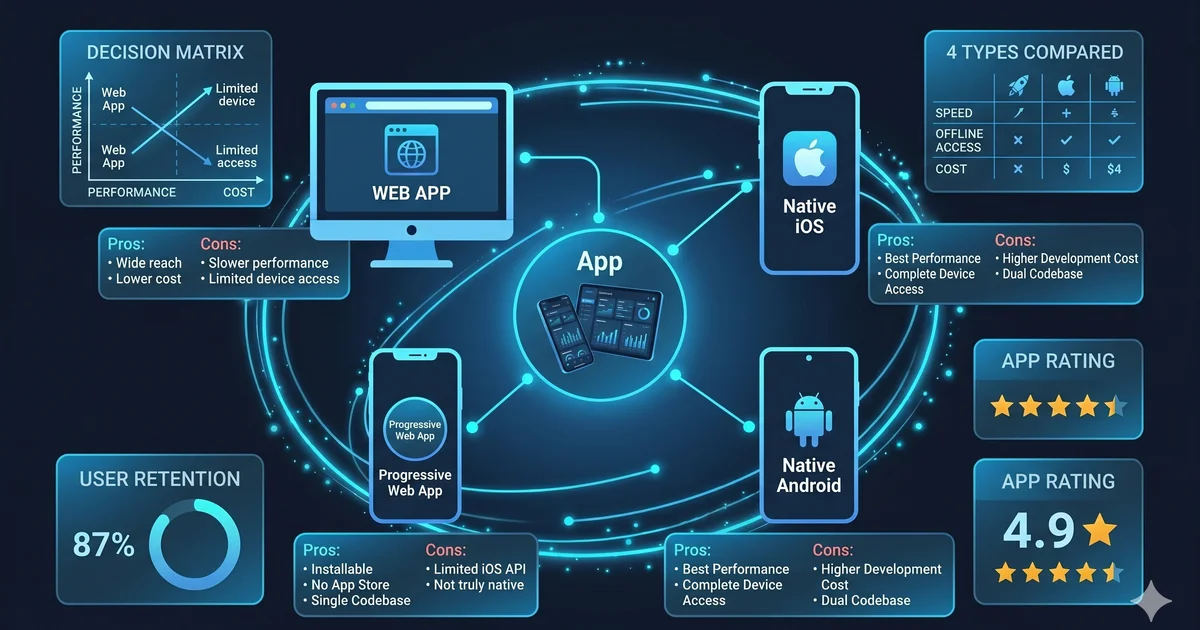
1. Native Applications
These are developed on a platform that allows them to function on any operating system.
An interesting feature of these applications is the ability to access multiple functions of a single device, such as a mobile phone, in a simplified way.
This type of application is one of the most widely available on app stores, allowing the use of external resources that complement the app. So much functionality comes at a cost, which tends to be high for development.
The advantages of this application model are: stability, no need for a permanent internet connection to use it, no loss of quality of the content used, ease of updating, and a low margin of error.
As a result, it is an ideal tool for demanding users who need a practical, agile, and efficient service.
2. Hybrid Applications
This type of application is a blend of native and web applications, a detail that can already be noticed in its language, which tends to be programmed in CSS, HTML, or JavaScript. It can be downloaded from a store or accessed via a browser.
This option is ideal for companies that do not have sufficient capital for the development of a native application and optimise their processes through paid or free use.
3. Web Applications
These have a design very similar to conventional applications, but with the particularity of only being accessible through a browser. They are not quite applications in the traditional sense, but they can also be categorised within mobile design.
The positive points of web apps are the low development cost and the fact that there is no need to wait for availability on an app store.
That is, they can be used at any time, eliminating bureaucratic processes from the working routine, provided there is internet access.
What is the best option for the company and how to choose it?
With several types of applications available, entrepreneurs and business owners must ask themselves which is the best for their business.
The choice can vary greatly depending on the company's needs. One tactic that can help in the selection process is considering whether or not the business's services require an application and whether the target audience finds this resource relevant.
Carrying out tests and research, for example, are ways of understanding the needs of the company and the public, finding a profitable solution.
Furthermore, once the type of application has been defined, it is necessary to hire a company to develop the application, as the knowledge and experience of the professionals involved greatly aids in the development of excellent tools.
Paying close attention to design is also very important to attract the public's attention and ensure positive results.
The process of choosing the type of application and the developer is something that requires time and careful assessment. Therefore, reviewing all possibilities for the company is the way to achieve improved productivity and results in the business.
Some of the most widely used types of applications and tools are: Google Drive for file storage, Trello for routine organisation, and ERP systems for business management, among others.
Applications that help people
Having tools that solve people's everyday problems is something that can generate excellent returns for business owners.
A job listings app, for example, is a very interesting concept that can attract many users looking for employment, as well as different companies wishing to join the platform, reaching a broader audience.
The platform can cover various sectors or a specific niche, thus addressing different demands.
Having a simple and dynamic interface, attractive design, and intuitive functionality is fundamental so that people can use it with ease.
Such options can offer many advantages not only to candidates but also to companies, something that draws the attention of the entire market and enables a more diverse operation.
For individuals, the benefits are as follows:
- Dynamic and simple application;
- Excellent hiring opportunities;
- Ensures more accurate and optimised recruitment processes;
- Increases the chances of finding vacancies near your area;
- Smart analysis and simplified CV application.
For companies, the main benefits consist of fully online operation requiring no installation, the ability to manage recruitment processes through the platform, filters that optimise selection, and a reduction in recruitment costs.
With many positive aspects, individuals who wish to work in a given sector, for example, can find a wide range of vacancies in this type of application.
This ability to find jobs in the desired area of work is possible thanks to technological evolution.
Moreover, the emergence of types of applications that allow people to find work and help managers optimise their time during recruitment processes is something very interesting and advantageous for everyone involved.
After all, recruitment processes become simpler and faster, and can generate savings of up to 30%.
Benefits of using applications in companies
With technological advances, the use of resources that help in business management is a way of keeping everything properly organised and, in turn, achieving good results.
The use of different types of applications is something that can be implemented across many segments, from manufacturing to sales processes, training, and events.
Investing in the use of apps in business is the path to achieving the following gains:
- Simple and quick access to systems;
- No need for a specialist to operate the application;
- The app provider can carry out updates whenever necessary;
- Can be accessed whenever needed from different devices;
- They are intuitive;
- Payment can be made according to usage.
With significant gains, entrepreneurs can invest in the use of applications in their businesses, as it is a technological resource that facilitates the management and organisation of the entire workflow.
In veterinary clinics, for example, demand for X-rays for pets is very common.
In this way, using systems to manage the number of veterinary X-ray procedures is a way of organising cash flow, keeping everything in order at the establishment, and planning a more dynamic and effective schedule.
Platforms that help in document preparation
The creation of reports and documents that show the working environment of professionals is something mandatory for companies, providing a broad view of existing procedures and bottlenecks.
In this context, a workplace risk prevention plan, for example, is a very important procedure that companies must carry out to keep working environments safe for their employees.
This management is established in occupational health and safety regulations and, with a system optimised with maintenance or training deadlines, professionals provide greater safety for everyone.
To achieve this, it is necessary to seek the implementation of improvements so that employees feel protected and can carry out their activities with excellence, and the implementation of types of applications and software for this management proves decisive for the quality and effectiveness of processes.
The benefits of an efficiently executed risk management process are:
- Improved productivity;
- More efficient operations;
- Increases credibility;
- Facilitates the implementation of preventive measures;
- Reduces incident rates;
- Reduction of costs and risks;
- Contributes to sustainable development.
With many interesting benefits, dedicating time to preparing a report on the possible changes that need to be made and initiating them through management tools can be highly worthwhile.
Remember that risk management is just as important as a structure capable of keeping the company's assets and employees protected throughout the entire working day.
In this way, investments in types of applications that aim to optimise time and provide clearer control over the necessary processes become a differentiating factor for the company's performance and full development.
After all, agility in the company's activities and improved quality of services are ways of achieving good results, increasing credibility, and winning the preference of clients.

Fixed-scope project from €5k to €50k
Defined scope, fixed price, delivered in 90 days. Real product with a senior Brazilian team supervised by a strategic CTO.
Request diagnosis