
6 Steps to Choose the Best Collaborative Digital Tools
The internet and technology are highly important and impactful today, being responsible for various aspects of the entertainment, commercial, and even economic sectors, where a variety of tools are used to achieve objectives.
When we think about how to reach a particular goal, we can often picture it, but the process and journey to get there can be disorganised and rushed, lacking the collaboration or harmony necessary for tasks to unfold properly.
Following this line of thinking, today's article will cover six steps for choosing the best collaborative digital tools for your business, whether it is a small logistics company or a large corporation.
Let us start by saying that the commercial environment can be a real mess if you are new to it or if your company cannot manage all its processes smoothly, it can be a challenge for anyone who enters it.
Projects are becoming increasingly demanding and require more collaboration from all parties involved, so without the necessary resources to optimise that process, your company can waste a great deal of time and energy unnecessarily.
Any company can and should use technology to its advantage to improve processes and deliver good work more quickly and, above all, more efficiently for its clients.
Following this thinking, it is natural that tools have been developed to improve collaboration among different employees within companies, helping them communicate and work better.
In the next sections, we will cover guidance to help you through the process. Get ready to read and understand how these digital tools can act as a success engine for your company.
The concept of a collaboration tool
First and foremost, it is important to truly understand what these tools are and how they work. Think of them as a kind of space where it is possible to manage the various tasks and demands of a team relating to a project.
This makes it far simpler and easier to communicate with everyone involved in projects and in each specific stage, allowing you to monitor and manage tasks, streamlining all surrounding processes and increasing effectiveness.
However, it is common for many companies to have multiple applications and software that employees use, increasing the knowledge required, whether for designing a project or starting a new one.
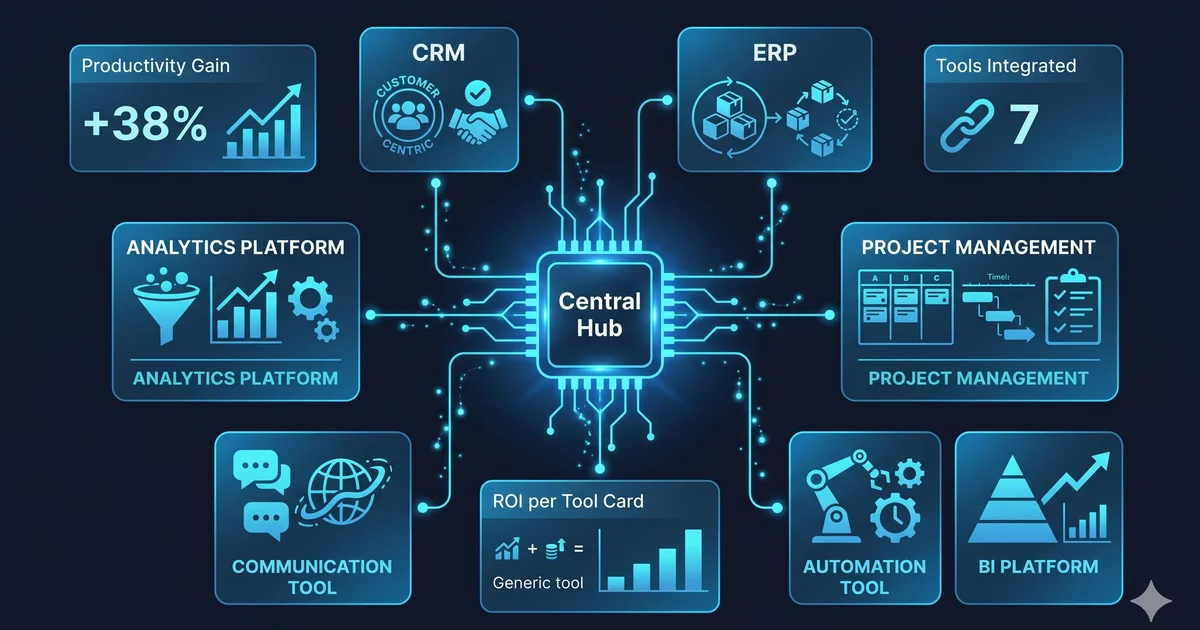
It can therefore be said that the secret lies in choosing the software that brings together multiple features in one place and helps carry out all those functions quickly, simply, and directly, increasing control over the project.
Therefore, when thinking about choosing the software that best suits your company or your team's style, keep the following elements in mind:
- Ease of communication;
- Transparency in communication;
- Centralisation of responsibilities;
- Productivity;
- Monitoring;
- Easy access from multiple locations.
Of course, the software alone will not be enough to eliminate all the problems a department faces when developing projects, but it can genuinely be what is missing for better task management and project completion.
How to choose the best tool?
Choosing the best collaboration tool may not be a simple task, and if you do not know exactly what you are looking for or simply have no knowledge of the area, some very wrong decisions can end up being made.
With this in mind, find out how to choose the one that best fits, and how to understand your needs, in 6 simple but important steps. From there, it will be much easier to apply it to your project, for example.
01 - Evaluate the costs
When considering implementing any tool in a company, the first major element to consider is the cost that such an action will entail and how much money your organisation is willing to invest, in addition to the return it can generate.
Some tools are free; others are more expensive. It is therefore necessary to assess how much is being invested and what is expected to be achieved with the acquisition. Sometimes, the investment can be very high for a small team.
With a clear picture of how many people will use it and what the monthly costs are, both for maintenance and acquisition of the tool, it will be simpler to estimate the cost and how it can be applied to project development.
02 - Think about system integration
System changes always cause problems and headaches for any company, especially when they are not integrated, a full effort is required to make it happen.
Therefore, when choosing a collaboration tool, think about its integration with the systems you already use in the business, which greatly facilitates implementation and makes it far more efficient. If you already work with Google tools, that is already a good starting point.
03 - Customisation is essential
Every team has its own way of working, its own challenges, qualities, and particularities. Therefore, when engaging a collaboration tool, it should be customisable to a level that accommodates the unique aspects of your team.
Even if the work is collaborative, it is important that each member can customise tasks in the way they prefer, enabling them to perform the work equally effectively.
04 - Ease of use
There is no point in finding the perfect tool that meets your needs if, on top of being very complex and difficult to use, it takes a long time to set up and creates more problems than it actually solves.
Therefore, when you decide to implement this system in your company, think and research the ease of use of the tool, as well as accessibility and which platforms can access the system.
05 - Digital security matters
The digital world is full of cybercriminals seeking to obtain data from companies and ordinary people. For this reason, digital security is a factor that is also widely discussed and developed.
Even if the team does not work with confidential information, it is important to understand and choose a tool that has no history of data breaches and that has strong criteria to increase the security of your data, both yours and your clients'.
06 - Think about automated processes
Today's environment is defined by the efficiency and speed of processes. The better a tool solves your problem and the faster it does so, the more efficient it will be and, consequently, the more companies will seek it out.
Automated tools typically find ways to perform repetitive tasks far more quickly, as well as improving the flow of all tasks recorded within them. This is especially essential if the team has many demands throughout the day.
Discover the benefits of collaborative tools
As with any business decision, it would only be worth investing in collaboration tools if they brought some benefit to the company, whether a return on capital, increased brand reach and relevance, or optimisation of time and resources.
When we think about this type of tool, some benefits and advantages stand out, such as greater productivity on the part of the professionals involved, who will have more time to dedicate to truly impactful tasks and demands.
Another point to note is that the company's profits increase. This is because, with employees producing more, the number of products or services provided by the company will grow and, if there is sufficient demand, the number of sales and profit will also rise.
This is without mentioning the increased reach of people engaging with your work. The more people acquire what you have to offer, the greater the public awareness of what is developed in your business, and consequently, the more people will come to know it.
A promotion effort through social media can also be effective in achieving that level, but engaging a collaboration tool for your team is impactful and can be the difference between a successful delivery and a failure.
Final considerations
Today's article addressed and explored collaborative digital tools in depth, and how they can impact your business as well as the routine of various departments within the company, showing the advantages and benefits, tips, and guidance on how to apply them.
Each company works differently, has its own mission, vision, and values, its own market potential, and a specific target audience, therefore, the choice varies and it is necessary to know your organisation and the work it does extremely well.
Now that you have a better understanding of how this concept works, use the information provided throughout the article to apply it in your business, making the most of your organisation's strengths.

Product with proven ROI in real data
Sthealth reduced billing errors from 15% to 4% in 60 days. See how strategic data transforms operations.
View case studies