
How to Build an MVP in 90 Days with a Fixed Budget
Most content about MVPs is written for founders with flexible timelines and open-ended budgets. "Build, measure, learn" sounds straightforward when you can iterate indefinitely. For founders with a fixed budget and a hard deadline, the math is different.
This article is for that second group: founders who have $5,000–$15,000, 90 days, and need a functional product at the end. The good news is that 90 days is enough. The bad news is that most failed MVPs fail not because of the timeline, but because of how scope gets defined at the start.
What an MVP actually is (and what it isn't)
MVP stands for Minimum Viable Product: the smallest product that validates a business hypothesis with real users. Not a Figma prototype. Not a landing page with a waitlist form. Not a feature-complete "lite" version of your eventual product.
A real MVP has three concrete properties: a complete end-to-end flow that works, real users able to perform the core business action, and enough data to decide whether the direction is right.
What an MVP is not:
- A clickable prototype in Figma (that's a design artifact, not a product)
- A landing page with a sign-up form (that's demand validation, not an MVP)
- A product with "80% of the features" you plan to ship "when it's complete"
The distinction matters because most teams build the wrong thing and call it an MVP. That produces wrong conclusions about product-market fit and wastes the budget that was supposed to find it.
What can be built in 90 days for under $15,000
The answer depends entirely on scope. With the right constraints, here's what's achievable:
- B2B SaaS with one complete core module
- Two-sided marketplace with buy/sell flow
- Booking platform with payments
- Internal ops tool automating one critical process
- B2B portal with onboarding, dashboard, and alerts
- Social feed with algorithmic ranking
- Custom payment processing (use Stripe)
- Native iOS and Android simultaneously
- Dozens of third-party API integrations
- Regulated products (fintech, health) requiring compliance
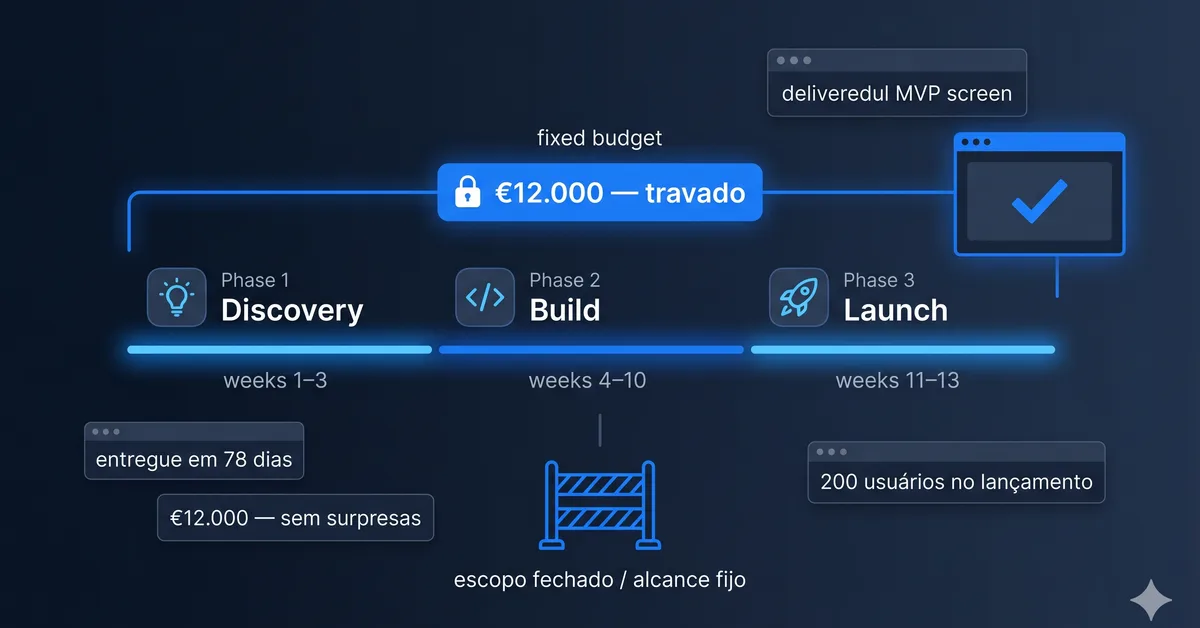
Budget and timeline are fixed. What changes is scope. Fixed-price software development works exactly this way: the provider and client define what's in the MVP before development starts, not during.
Why most MVPs fail
It's rarely the technology. The patterns that cause failure repeat across contexts:
Scope creep without control
The initial scope looked reasonable. Then, during development, "small" features got added that weren't in the original plan. Each one seemed trivial. Together, they doubled the development time. The MVP arrives late, over budget, and without having validated anything.
No prior problem validation
The most expensive mistake: building an MVP for a problem that either doesn't exist or that users won't pay to solve. Before writing a line of code, you need real evidence that the problem exists, that people suffer from it, and that they're willing to pay for a solution.
Perfectionism disguised as quality standards
Some teams don't ship because "it's almost ready." In 17 years of building products, that "almost" never arrives on its own. An MVP is good enough when it allows learning, not when it's perfect.
The 3R Framework for fixed-budget MVPs
The 3R Framework (Friction, Rule, Return) is the method BeC uses to define MVP scope before any development begins. It's designed specifically for the constraints most content ignores: fixed budget, fixed timeline, no room for scope drift.
Friction: what specific problem does the user face today? Not the problem you think they have but the one you can verify through data or direct conversation. Poorly defined friction leads to solutions nobody uses.
Rule: what constraints exist? Budget, timeline, team capacity, legal requirements, mandatory integrations. The rules of the project determine what's achievable in the time available. Ignoring them produces plans that don't survive contact with reality.
Return: what has to happen for the MVP to be a success? Defining the success criterion before building changes how scope gets prioritized. An MVP without a clear definition of "validated" can't fail, but it also can't succeed.
When all three filters are answered before development starts, scope closes naturally. What doesn't pass the 3R filter doesn't enter the MVP, regardless of how good the idea sounds. That's what makes 90-day delivery without surprises possible.
Got an idea? Let's define your MVP scope in 60 minutes, free.
One session is enough to apply the 3R Framework to your product and define a realistic MVP scope. No commitment required.
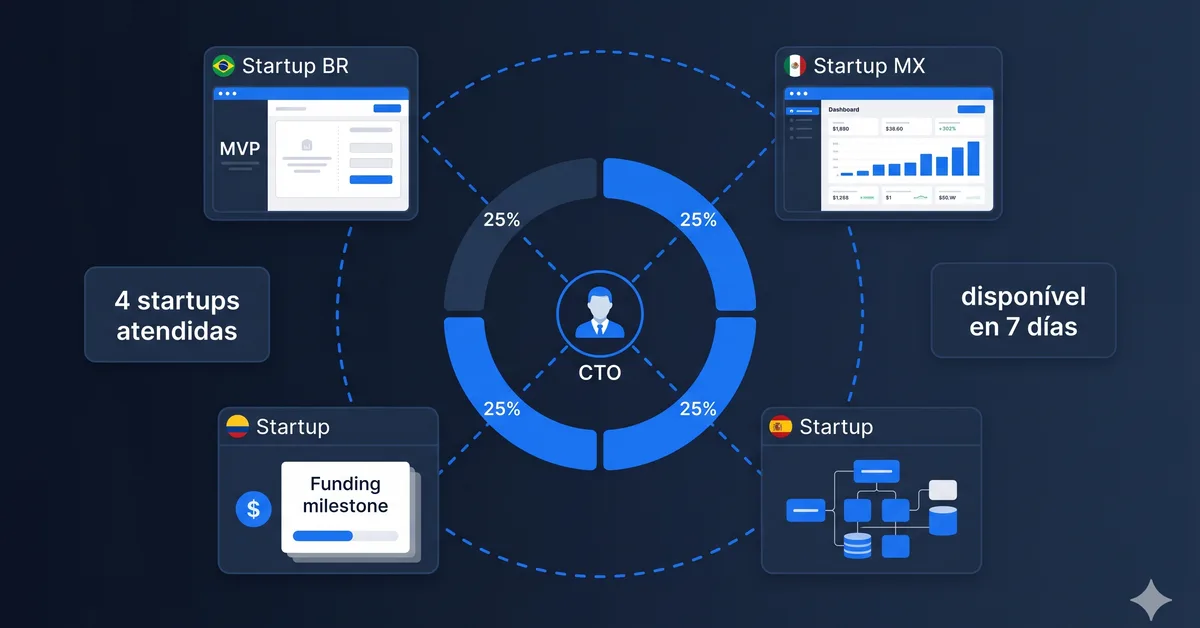
Talk to the CTO, free →What happens after 90 days
The delivered MVP isn't the final product. It's the start of the learning cycle. With real users on the system, you have data to decide what to build next based on evidence, not assumptions. The second iteration is usually faster and cheaper because the uncertainty from the first round is gone.
For projects at very early stage, where the problem hypothesis itself hasn't been validated, a direct conversation helps clarify whether an MVP makes sense at all before committing budget to development.

Technology that shows up in the P&L
Code that generates revenue, not slides. Projects closed with scope, price, and deadline defined before the start.
Request a quote